
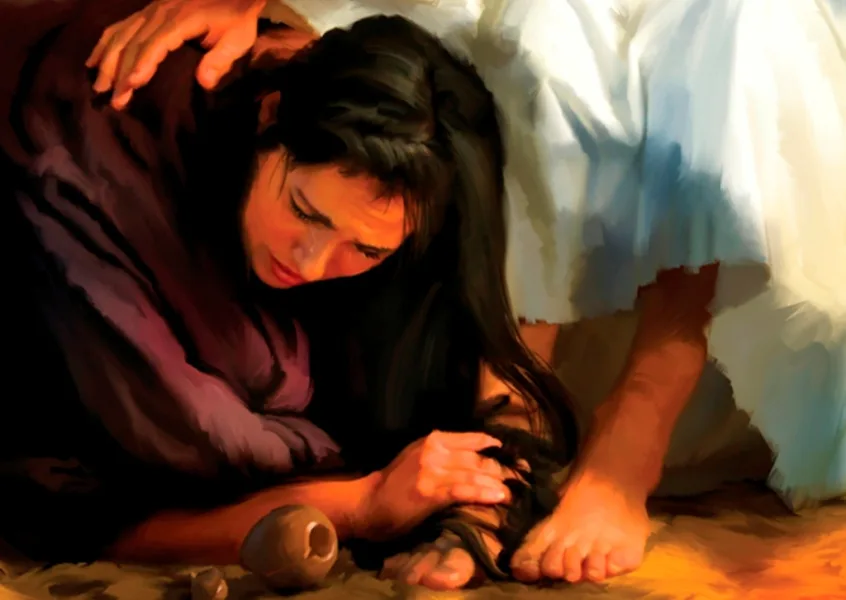
“ And behold, there was in the city a woman who was a sinner, and when she learned that Jesus was sitting at the table in the Pharisee’s house, she brought an alabaster flask of perfume; and standing behind Him at His feet, weeping, she began to wet His feet with her tears and wiped them with the hair of her head, kissed His feet and anointed them with the perfume” – Luke 7:37-38
How many of us have felt bad about something we said or did? How many of us would like it if we could redo a moment, erase a past experience? How many of us, after having come to know the kindness of God, have said: “Lord, why did you not reveal yourself to me sooner?”, thinking of the empty and dissolute life we were living. Sometimes guilt makes us fall into slavery to our feelings or into prey to the enemy who accuses us. And we are suffering the shame of sin, of our mistakes, enduring the accusation of the enemy that comes to you in many ways: through the rejection of those who once called themselves your friends, gossip, and above all your own conscience. And we forget that God is there, walking with us, standing at the window of our life, seeing everything and waiting for the moment to intervene. And instead of condemning you, He forgives you, and He also forgets.
However, we cannot understand the greatness of God’s forgiveness if we do not understand the gravity of our sin. The psalmist declared: “How blessed is he whose transgression is forgiven, whose sin is covered! How blessed is the man to whom the Lord does not impute iniquity, and in whose spirit there is no deceit!” – Psalms 32:1-2. Notice that the psalmist uses three words to refer to sin: “Transgression,” “sin,” and “iniquity.” The word “transgression” means to break free or separate from God, which is also translated as rebellion. “Sin” means to miss the mark, to do something that does not please God or is outside His will. “Iniquity” means perversion or wickedness. But he also uses three words to speak of forgiveness: “Forgiven,” which means lifted up. “Covered,” which means hidden or invisible. And “not imputed” means erased or not recorded. This is magnificent! There is restoration in God for everyone who believes and seeks Him! And it catches my attention that each of those words related to sin, in its original Hebrew word, also means “offering,” because the sacrifices and burnt offerings for sin are an offering that seeks God’s forgiveness. And so I understand that our sin carries within itself the offering of forgiveness. Christ was made sin and was also the offering for our sins. That is why Christ is the propitiation for our sins, so that His death is the offering that forgives our transgression, covers our sin, and erases our iniquity. Therefore, when we understand the implication of our sin, we can receive and understand the significance of forgiveness, because Sin takes us away from God, but it also brings us near.
The theme verses speak to us of this truth. First, let us look at the historical context of these verses in order to understand this beautiful teaching. The Word says: “One of the Pharisees was asking Him to dine with him; and He entered the Pharisee’s house and sat down at the table” (Luke 7:36). In some versions it says that he begged Him, not because he knew who Jesus was, but because his intention was to examine Him, to humiliate Him in front of the others. The word “Pharisee” comes from the Aramaic word peres which means divided, separated. This sect began as pious men who wanted to remain pure, but that zeal led them to become religious hypocrites who deified the Mosaic law. They felt superior to others and valued the external manifestation of the commandment more than the Spirit of the law. Their emphasis was on forms rather than on the rightness of actions. They criticized Jesus in everything, yet they recognized Him as a teacher. At that time, when someone was invited into the home, it was an opportunity to hold debates on religious topics. That is why it is not strange that he allowed that woman, known as a sinner in the city, to enter under his roof. People would come and enter homes, but they stayed in the background, watching and listening.
In ancient times there was no table like the one we use now; rather, people reclined to eat, or knelt on their knees. In the original, what is translated as “sat down at the table” is the word anaklino, which means to lie down, to recline. And as Jesus was reclining there, that woman came in, contrite to the point of tears. It is good to make clear to you that this incident was recorded only in Luke, and not in the other synoptic Gospels (Matthew and Mark). Luke specifies that she was a sinful woman of that city, and he does not give her name, but she was neither Mary Magdalene nor Mary the sister of Lazarus, of whom it is also recorded that they anointed the Lord. This is an isolated incident. But at this dinner there are several characters: there is the Lord, the host, who is the Pharisee, the woman of the city, and those who went to watch.
To follow the order of the narrative, let us first look at the woman. “And behold, there was in the city a woman who was a sinner, and when she learned that Jesus was sitting at the table in the Pharisee’s house, she brought an alabaster flask of perfume; and standing behind Him at His feet, weeping, she began to wet His feet with her tears and wiped them with the hair of her head, kissed His feet and anointed them with the perfume” (Luke 7:37-38). The Word says that she heard that Jesus was in that place. Somehow this woman had already had an encounter with the Lord, and she had a revelation of Jesus, for only the one who recognizes Christ as God, Lord, and Savior can bow down at His feet (John 8:24). Only the one who recognizes Jesus can receive forgiveness of sins; in Him there is power to forgive. It is possible that she had heard the message of the kingdom, with the good news of salvation; somehow this woman had heard the Sermon on the Mount and what God thought about judging others, loving enemies, and praying for those who insult and persecute you. That woman’s ears had been opened and she could understand that in God there is forgiveness, that in God there is restoration, there is mercy, there is love, and she believed it.
Some translations say that she was known as a sinner in that city; she did not necessarily have to be a prostitute, but everyone knew that she led a life outside the will of God. In our language today, we would say, a libertine, a worldly woman. I imagine that when she walked through the streets, people turned to look at her, and murmured and condemned her, but she had found someone who showed her the love of God; someone upright, yet loving, just, yet not accusing. Then she ran, I imagine she reached her home, and looked for that flask, fine, costly, which held that perfume of great value… Perhaps she had kept it for years for when she would marry, to anoint herself and to anoint the beloved of her heart, and at last he had come, someone who looked at her with compassion, with mercy, with love. To that man she had to show her love, her gratitude. I imagine she turned the whole house upside down, weeping with happiness, and when she found the alabaster flask she ran to meet Him.
Upon arriving at the Pharisee’s house, she found Jesus reclining, and she threw herself at His feet, weeping. And I want to draw your attention to the attitude of that woman. She did not think about where she was, nor about what the others were doing; she only saw that Jesus was there, and her heart was set on Him. Sometimes we hold back from worshiping God in freedom because of what people will say, but when the object of our worship fills our whole heart, nothing else matters to us. Now notice what she did: and it says in verse 38: “… began to wet His feet with her tears and wiped them with the hair of her head, kissed His feet and anointed them with the perfume.” The act of being at His feet represents submission, humility, worship, but above all love. Feet are a type of our humanity, but they also represent the holiness of God, as in man his humanity (Exod 3:5). The feet of Jesus symbolize the source and the place of God’s grace, which is why those who recognize themselves as sinners come to the feet of Jesus. Those who want to learn from Him also sit at His feet. But it is one thing to be at His feet and another to be under His feet. Worshipers come to His feet, because the feet of God symbolize His majestic presence. But those who are defeated and are enemies of the kingdom are under the feet of Jesus Christ.
Now let us think about the weeping of that woman. We weep from pain and we weep from joy. Tears represent our fragility, which is why they are so valuable to God. It says that He keeps them in a bottle; our tears move Him, especially those that are the result of an injustice, of the acknowledgment of a fault, of our powerlessness. On the other hand, long hair represents glory in a woman, but wearing it loose, in that time, was a dishonor. But she did not mind bearing that disgrace, and like David she made herself more vile, in order to show her surrender to God, her devotion to the Lord, like the slaves who were accustomed to drying their masters’ feet with their hair. An attitude of total surrender.
It also says that she kissed His feet. A kiss is the Greek term filema. At that time it was a Christian characteristic to kiss one’s brethren (the holy kiss the apostle Paul spoke of), as a sign of sincere affection. The origin of that word, philema, comes from fileo, which is to love fraternally, sincerely, the brethren. But in this account the verb kataphileo is used, kata intense, fileo love, an action that measures the intensity of the feeling. That is, it was not a simple kiss that she gave Jesus, but she kissed Him ardently, intensely; it is to give a kiss, and another kiss, and another kiss, and another kiss. A kiss, in a figurative sense, shows respect, devotion, and submission, as it says in Psalms 2:12 “… kiss the Son, lest He be angry”. And the Hebrew word here is nashak, which is translated as to honor, to join, to cling, to rule together, to kiss. A kiss also conveyed character and dignity (Abraham with his sons, Samuel with David). In the case of this woman, with her kisses she was telling Him: “I love you, I respect you, you are my King, you are my Lord, I surrender to you.”
And lastly, it says that she anointed His feet with perfume. To anoint is to consecrate, to set apart, to dedicate. The perfume was of myrrh (Heb. muron), which figuratively speaks to us of the graces of the Messiah. In Christ there is grace, there is the favor of God. Beautiful are the feet of those who announce peace, the good news of the Lord. In Christ we receive grace, forgiveness, mercy from God. We are great sinners, but God is a great Savior. Hallelujah!
Looking at this scene is touching; it inspires devotion. However, look at how the Pharisee saw it: “Now when the Pharisee who had invited Him saw this, he said to himself, If this man were a prophet, he would know who and what kind of woman this is who is touching Him, that she is a sinner” (Luke 7:39). The Pharisee saw her as a sinner, unclean, and Jesus as a nobody. And look at what happened: “And Jesus answered him, Simon, I have something to say to you. And he said, Say it, Teacher. A certain moneylender had two debtors; one owed five hundred denarii and the other fifty; and when they had nothing with which to pay, he graciously forgave them both. Which of them, then, will love him more? Simon answered and said, I suppose the one whom he forgave more. And Jesus said to him, You have judged correctly. And turning toward the woman, He said to Simon, Do you see this woman? I entered your house and you gave Me no water for My feet, but she has wet My feet with her tears and wiped them with her hair. You gave Me no kiss, but she, since the time I came in, has not ceased to kiss My feet. You did not anoint My head with oil, but she anointed My feet with perfume. For this reason I say to you that her sins, which are many, have been forgiven, because she loved much; but he who is forgiven little, loves little. And He said to her, Your sins have been forgiven” (Luke 7:40-48)
It is curious that the name Simon means “examiner,” “to hear.” We, like the Pharisee, look at others and already believe we know them, that we know who they are, and we condemn them. Yet God, who does know our hearts, does not despise us, not because we are good, but because He loves us and therefore forgives us. But when Jesus said to him “Do you see this woman?”, the word He used for “see” was not seeing (Gr. eido) with the eyes, as Simon saw, but (Gr. blepo) perceiving with the mind, going beyond an outward knowledge, looking the way God looks. In order to bring him to that perspective, He used the illustration of the two debtors. But the difference between these two cases does not lie in the debt itself, but in the fact that both are debtors. Both were under the same condemnation. The problem here is one of conscience, of how we perceive ourselves and perceive others, without taking into account that we are all debtors before God. We are all debtors, and we cannot pay that debt, which is why salvation is free, not because it is worth nothing, since it cost God everything, but because we cannot pay for it.
The main teaching here is also not that when we sin more we love more—no, no, no. That would be like saying: let us do evil that good may come, by no means. Love is NOT rooted in sin, but in forgiveness. It is God’s forgiveness that made her love much, and not the other way around. This woman came to Jesus not so much to receive forgiveness, but to reciprocate love for the forgiveness received, because she was repentant, and she recognized that in God there was love and forgiveness. We love God because He first loved us. To love God much we do not have to sin much; that is not the point; it is to appreciate and recognize who He is. This woman’s attitude reminds us that true love and sincere devotion for Christ must proceed from a full awareness of the gravity of past sins and of the love of God manifested in His forgiveness.
Simon loved so little that he did not even show the rules of hospitality that were used in that time of washing the guests’ feet, giving them a kiss, and also anointing them. It is in the way we treat people that we show our affections. For example, if someone arrives at your house and you are watching TV, you say: “Oh, wow, you here, what a surprise, come sit down…” and you keep watching the program. Obviously it is as if no one had come to visit you. But if it is someone who really matters to you, you immediately turn off the TV, greet them with affection, and call the family to welcome them. In the case of Abraham, when he recognized that those men with the Lord were passing by his tent, the Word says that he ran out of his tent to meet them, and bowed himself to the ground, and said: “Lord, if now I have found favor in your sight, I pray you, do not pass by your servant” (Gen. 18:3). We can honor God with our words, and say that we love Him, but our heart may be far from Him (Mark 7:6). Only by recognizing how much we have sinned (not in the quantitative sense, but the qualitative) will we be able to be at His feet.
Finally, it says: “Those who were sitting at the table with Him began to say among themselves, Who is this man who even forgives sins?” (Luke 7:49). These men, like Simon, were sitting with the Lord, but their attitude was to judge, to watch how He receives, how He thinks, what He is like. In the same way, many of us go to church to look at those around us, to judge the sermon, to point fingers, to condemn, when we could be at His feet in front of His Presence. They did not see that the One who was there was Immanuel, God with us, because their hard hearts would not let them see. But she, who had indeed received that revelation, first of all recognized Jesus Christ: 1. as God and Creator, showing an overflowing love when she bowed down to wet His feet with her tears and dry them with her hair; 2. as Lord and Savior, showing submission to His authority when she kissed His feet intensely; and 3. as Messiah and King by honoring Him when she anointed Him with perfume. Therefore, the Master said to her: “Your faith has saved you; go in peace” (Luke 7:50).
There is an Arabic proverb that goes like this: “The sword bends the neck; but only another heart can bend a heart.” The love of God is irresistible; let us bow our hearts to be eternally at His feet, like that woman, worshiping Him, recognizing Him, honoring Him. May that always be our desire, to be always at His feet, not as an outward form, but in the inner humility of one who, impacted by His forgiveness, loves Him and worships Him with all his heart. Amen.
Contribution by: Marítza Mateo